

Range anxiety is the primary hesitation for buyers considering their first electric vehicle — and the 2027 Volvo EX60 addresses it more thoroughly than any Volvo before it. With up to 322 miles of EPA-estimated range, 800V fast charging architecture, and a NACS charging port compatible with the largest fast-charge networks in the country, the EX60 is designed to make range a non-issue for daily Long Island driving.
Bottom Line: The EX60 offers up to 322 miles of EPA-estimated range with AWD, uses 800V charging for faster DC top-ups, and plugs into the NACS network — including Tesla Superchargers — for widespread fast-charge access on Long Island and beyond.
- RWD delivers up to 307 miles from an 80 kWh usable battery; AWD delivers up to 322 miles from a 92 kWh usable battery
- 800V architecture enables significantly faster DC fast charging than 400V competitors at the same charger power output
- The 19.2 kW onboard charger supports fast Level 2 home charging; a standard home installation covers daily needs overnight
Understanding the Range Numbers
What 307–322 Miles Means in Practice
EPA range estimates are produced under controlled conditions and represent a useful benchmark, not a guaranteed real-world figure. Actual range varies with speed, temperature, climate control use, and driving style. That said, the EX60’s range figures are strong enough that most Long Island drivers will find daily range anxiety a non-issue.
Common Long Island distances:
- Huntington to Manhattan: approximately 45 miles one-way (90 miles round trip)
- Huntington to Montauk: approximately 85 miles one-way
- Huntington to JFK Airport: approximately 35 miles one-way
An EX60 AWD with 322 miles of range covers the Huntington-to-Manhattan round trip roughly 3.5 times on a single charge. Even at 70–80% real-world efficiency in cold weather, daily Suffolk County driving is well within range.
Cold Weather and Range
The heat pump standard on every EX60 is a meaningful advantage in Long Island winters. Resistance heating — the simpler approach used in some EVs — draws heavily from the battery, reducing range by 20–40% in cold conditions. A heat pump recovers ambient heat much more efficiently, substantially reducing that winter range penalty. This is not an optional upgrade on the EX60; it is standard equipment.
Charging Options Explained
Home Charging: The Primary Method
For the vast majority of EX60 owners, home charging is the answer to 95% of charging needs. Install a Level 2 (240V) charger — also called an EVSE — in your garage or on the exterior of your home, and the EX60 charges overnight from a low state to full.
The EX60’s 19.2 kW onboard charger is a high-capacity unit that maximizes the speed at which AC power is converted and stored. With a compatible Level 2 charger, the EX60 can add roughly 25–30 miles of range per hour, meaning a typical overnight charging window (8–10 hours) is more than sufficient for a full charge.
DC Fast Charging: For Road Trips and Top-Ups
When you need to add significant range quickly — on a road trip to the Hamptons or a day trip to the city — DC fast charging is the answer. The EX60 uses a NACS (North American Charging Standard) port, which is compatible with Tesla Superchargers as well as the expanding base of NACS-native public fast chargers.
The 800V advantage is meaningful here. At any given DC fast charger power level, the 800V EX60 charges faster than a comparable 400V vehicle. Specifically, at a 400 kW charger, a 400V vehicle can only accept around half that power — the 800V system can absorb more, reducing time at the charger.
Level 1 (Standard Outlet) Charging
The EX60 can charge from a standard 120V household outlet, though this method is slow — typically adding 3–5 miles per hour. It is a useful backup but not a primary charging strategy for most households.
NACS Charging on Long Island
Tesla Superchargers — previously exclusive to Tesla vehicles — are now accessible via the NACS port on the EX60. There are multiple Supercharger locations on Long Island accessible to EX60 owners, significantly expanding the fast-charge network available without leaving the island.
Planning a longer trip? The EX60’s Google Built-In navigation integrates real-time charging data, helping route trips through available fast chargers. Combined with the 322-mile AWD range, most Northeast destinations are reachable with one or zero charging stops.
Charging in Practice: A Typical Long Island Week
For most EX60 owners in Huntington, Northport, or Commack, the weekly charging routine looks like this: plug in at home on Sunday evening, wake up Monday with a full charge. Drive the vehicle all week for commuting, errands, and school pickups. Plug in again mid-week if needed (most won’t need to). The car never visits a public charging station except on road trips.
This pattern — home charging as the baseline, public charging as an occasional tool — is the reason EV ownership tends to work better than people expect coming from the gas station model. Fueling happens at home, overnight, while you sleep.
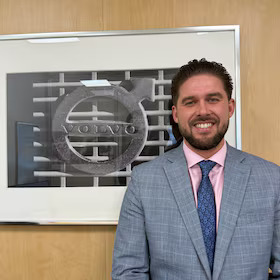
"The most common thing I hear from EX60 owners after a month is that they've stopped thinking about charging at all. They plug in at night, unplug in the morning, and the car is always ready. That's the experience the EX60 is designed to deliver."
General Manager, Volvo Cars of Huntington
View available EX60 models at Volvo Cars of Huntington or speak with our team about EV home charging setup.
Frequently Asked Questions
What is the EX60’s real-world range in winter? In cold weather, expect roughly 20–30% less range than EPA estimates depending on temperature, speed, and climate control use. The standard heat pump significantly reduces this penalty compared to resistance-heated EVs. At 80% efficiency in winter, the AWD still delivers roughly 250+ miles.
How long does it take to charge the EX60 from 10% to 80% on a DC fast charger? The 800V system and NACS port enable fast DC charging, but the exact time depends on the charger’s available power. At high-power stations, the EX60 charges significantly faster than most 400V competitors.
Can I use a Tesla Supercharger with the EX60? Yes — the EX60’s NACS port is directly compatible with Tesla Superchargers. No adapter is needed.
Do I need a special outlet at home for EX60 charging? A standard 240V outlet (like a dryer outlet) or a dedicated Level 2 EVSE circuit is recommended for practical overnight charging. A licensed electrician can install this. The EX60 can also charge from a standard 120V outlet, though very slowly.
How does the heat pump help in winter? A heat pump extracts heat from outside air rather than generating heat electrically. This is far more efficient — delivering 2–3x more heat energy than electrical energy consumed — meaning significantly less battery drain for cabin heating in cold months versus vehicles using resistive heating.
Questions about EV home charging setup or EX60 availability on Long Island? Contact Volvo Cars of Huntington, serving Huntington, Northport, Commack, and Melville.
Related reading: EX60 800V Technology Explained | EX60 RWD vs AWD Powertrain Guide