

The Volvo S60 Recharge’s 41-mile EPA-rated electric range sounds straightforward until you account for Long Island winter temperatures, actual charging habits, and whether your home setup supports Level 2 charging. This guide gives Huntington buyers the practical picture — not the ideal-conditions number, but what to expect on a January morning in Cold Spring Harbor or a July commute to Melville.
Bottom Line: Huntington buyers with garage access and a Level 2 charger installed can realistically drive the S60 Recharge on electricity for most local trips; buyers without home charging should consider the standard B5, which has no infrastructure dependency.
- EPA-rated EV range: ~41 miles; real-world winter range: approximately 28-32 miles in sustained cold
- Level 2 charging (240V): approximately 2.5-3 hours for a full charge from empty
- Level 1 charging (120V): approximately 10-12 hours for a full charge — functional but slow
Understanding the S60 Recharge’s 18.8 kWh Battery
The S60 Recharge uses an 18.8 kWh lithium-ion battery pack mounted in the vehicle’s floor. This is a plug-in hybrid battery, not a full EV battery — it’s considerably smaller than a dedicated electric vehicle like the Volvo EX30 or EX90, which reflects the Recharge’s role as a hybrid rather than an EV-first architecture.
The battery powers the rear electric motor, which drives the rear axle independently of the front-mounted gasoline engine. This setup creates AWD without a mechanical driveshaft — the electric motor handles rear traction, the engine handles front power, and the car’s management system coordinates both in real time.
When the battery is depleted, the car transitions seamlessly to conventional hybrid operation. There is no range warning or stranded-car scenario — the gasoline engine handles all propulsion once the battery drops below a management threshold, and the battery maintains a small reserve for hybrid assist.
For the full comparison between Recharge and standard S60 powertrains, see our S60 Recharge vs. standard guide.
Charging at Home: Level 1 vs. Level 2
Level 1 charging (120V household outlet): The S60 Recharge includes a cable that plugs into any standard 120V outlet — the same outlet as your toaster. No installation required. The charge rate is approximately 1.4-1.7 kW, which means a full charge from empty takes 10-12 hours. For buyers who drive less than 20-25 miles daily and charge every night, Level 1 is adequate. For buyers who need a full charge more quickly, Level 2 is the practical choice.
Level 2 charging (240V home EVSE): A dedicated Level 2 charging unit (technically called Electric Vehicle Supply Equipment, or EVSE) installed in your garage provides approximately 7.4 kW of charging power. A full charge from empty takes 2.5-3 hours — plug in after dinner and the car is ready by the time you go to bed. Installation costs in the Huntington/Suffolk County area typically run $500-$900 including the unit and electrician labor, depending on your home’s panel capacity and the distance from the panel to the garage.
Installer recommendations: A licensed electrician is required for 240V installation. Volvo Cars of Huntington can provide guidance on EVSE unit brands and local installer contacts.
Real-World Range in Nassau and Suffolk County Conditions
Summer (60-80 degrees F): Range closely matches the EPA estimate. Most Huntington drivers report 38-43 miles of actual electric range in warm weather with mixed driving. Highway driving at 65-70 mph uses battery capacity faster than local roads.
Spring/Fall (40-60 degrees F): Range typically falls 10-15% below EPA rating. Expect 34-38 miles of practical electric range. Climate systems running moderately reduce this slightly.
Winter (below 32 degrees F): Significant range reduction. Cold temperatures reduce lithium-ion discharge efficiency and add energy demand for cabin heating. Expect 27-32 miles of EV range during sustained cold — a meaningful reduction from the EPA number. Pre-conditioning the cabin while plugged in (available through the Volvo Cars app) reduces the battery drain from heating, since you’re warming the car on grid power rather than battery.
For a Huntington buyer whose round-trip commute is 25 miles, the car operates electrically even on cold winter days. A 40-mile round trip works in summer but may touch the gasoline engine on a February morning.
Public Charging in Huntington and Suffolk County
The S60 Recharge uses a J1772 connector for Level 1 and Level 2 charging — the standard North American AC charging connector. Public Level 2 chargers with J1772 are available at various locations throughout Huntington and Suffolk County.
Locations with public charging in the Huntington area include:
- Huntington Village municipal lots (check current status and availability)
- Select shopping centers along Route 110 and Route 25A
- ChargePoint and Blink network stations at larger retail developments
- Some employers in the Melville and Hauppauge business corridors offer workplace charging
Important limitation: The S60 Recharge does not support DC fast charging (CCS/CHAdeMO). This means public charging always occurs at Level 2 speeds — 2.5-3 hours from empty, or roughly 12-15 miles of range added per hour. A 30-minute public charging stop adds approximately 6-8 miles of EV range, which can meaningfully extend your electric driving on a day out.
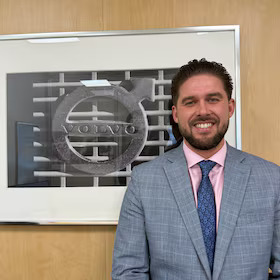
"The buyers who love their S60 Recharge are the ones who get a Level 2 charger installed at home and plug in every night without thinking about it. It becomes a habit in about two weeks. After that, they're telling me their gas station visits went from once a week to once a month."
General Manager, Volvo Cars of Huntington
The Volvo Cars App: Managing Your Recharge Remotely
The S60 Recharge connects to Volvo’s connected services app, which provides remote access to charging status, climate pre-conditioning, and vehicle location. Pre-conditioning is the most practically valuable feature: set the cabin to be 68 degrees F at your departure time, and the car heats or cools itself while still plugged in — consuming grid power rather than battery power. In winter, this recovers several miles of effective EV range by reducing the energy needed to heat the cabin after departure.
The app also displays state of charge, charging completion time estimates, and can schedule charging to off-peak electricity rate hours if your utility offers time-of-use pricing. National Grid and PSEG Long Island both offer rate structures where off-peak electricity is priced lower than peak — Huntington buyers can charge during off-peak hours (typically late night/early morning) to reduce the per-mile electricity cost.
Electricity Cost vs. Gasoline: The Huntington Math
Driving on electricity in the S60 Recharge uses approximately 4.5 kWh per 10 miles (EPA efficiency estimate). At $0.20/kWh (approximate PSEG Long Island residential rate), that’s $0.90 per 10 miles, or about $2.25 per 25 miles.
The equivalent gasoline cost for 25 miles at 24 mpg combined and $4.00/gallon: approximately $4.17.
Savings per 25-mile trip: approximately $1.92. Over 250 driving days per year at this pattern: approximately $480 in annual fuel savings. Over 5 years: approximately $2,400. Combined with the potential federal tax credit (up to $7,500), the economics strengthen substantially for qualifying buyers.
Frequently Asked Questions
Do I need a permit to install a Level 2 charger in Huntington? Most municipalities in Suffolk County require an electrical permit for 240V circuit work. Your licensed electrician handles this as part of the installation process. Permit costs are modest (typically $50-$150) and the process is straightforward.
Does the S60 Recharge battery warranty cover capacity loss? Volvo’s battery warranty covers defects in materials and workmanship. Capacity loss over time (a normal characteristic of all lithium-ion batteries) is typically not covered unless it falls below a specified threshold. Review the current warranty terms with Volvo Cars of Huntington’s finance team.
What happens if I leave the S60 Recharge unplugged for weeks? The battery retains its charge adequately over short periods. Extended storage (months) in a discharged state can affect lithium-ion longevity over time. Normal use without plugging in simply means the car operates as a conventional parallel hybrid — no damage results from not charging.
Can I charge the S60 Recharge at a Tesla Supercharger? No. Tesla Superchargers use a different connector (NACS/Tesla proprietary). The S60 Recharge uses J1772 (Level 2 AC) only. Some public charging networks are expanding J1772 compatibility; confirming connector type before visiting a station is good practice.
How long does the S60 Recharge battery last? Lithium-ion batteries in PHEVs typically retain 70-80% of original capacity at 8-10 years under normal use. The battery is warranted by Volvo for a specified period — confirm current terms at Volvo Cars of Huntington. Long-term data from comparable PHEVs suggests the S60 Recharge’s battery should support practical EV range well into the vehicle’s expected ownership period.
Plan Your Charging Setup Before You Buy
For Huntington buyers considering the S60 Recharge, the charging infrastructure decision should happen before the purchase decision. If you have a garage, installing a Level 2 charger is straightforward and worth doing. If you park on the street or in a building without charging access, the standard B5 or B6 delivers the S60’s driving experience without any infrastructure consideration.
Visit Volvo Cars of Huntington to see current S60 Recharge inventory and discuss charging setup options with our team.